
Juvenile Great Spotted Woodpecker
Juvenile Great Spotted Woodpecker: A Portrait in Early Life
Appearance and Distinctive Markings
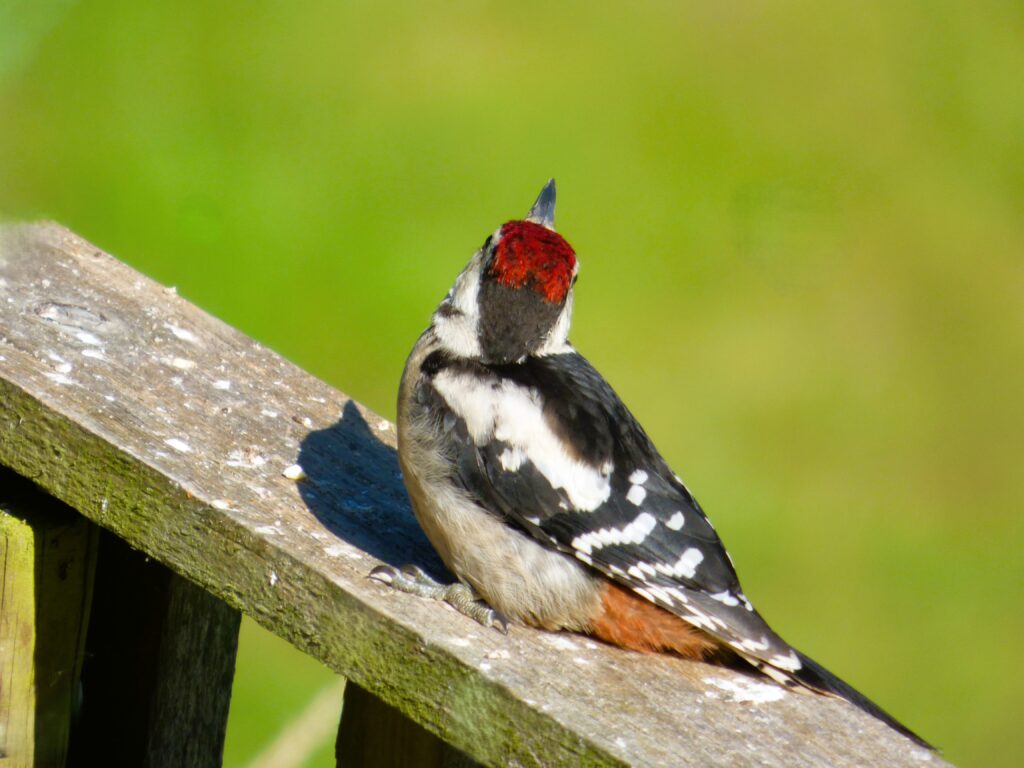
Juvenile Great Spotted Woodpeckers are immediately striking with their bright red crowns, a feature they lose as they moult into adult plumage. Their upperparts are more muted than those of adults, often tinged with brown, and their underparts may appear a shade paler or less clean. The bold black and white barring which defines adult plumage is present, but less sharply defined in juveniles. The lower belly of juveniles may show a pinkish hue instead of the vivid red seen on mature birds.
Sexing juveniles can be tricky. Some subtle differences arise as they mature: young males may develop a little extra red or stronger markings near the nape, while females tend to retain a cleaner crown pattern.
Nesting and Early Days
From hatching, juveniles are altricial blind, featherless, utterly dependent on their parents. The parents excavate a nesting cavity in a live or dead tree, creating an unlined chamber just deep enough to protect the brood. Typically, clutch size is four to six glossy white eggs, laid around April to June. Incubation by both parents lasts about 10 to 12 days. After hatching, juveniles stay in the nest for approximately three weeks before fledging.
Even after fledging, they rely on their parents for food. Each adult typically takes responsibility for part of the brood, feeding them for another roughly ten days until the youngsters gain independence.
Behaviour and Learning to Be a Woodpecker
Once they leave the nest, juveniles learn by doing often awkwardly. Their first flights can be tentative, and their movements along tree trunks are less confident than those of adults. They may hop or wobble as they try to cling and balance.
Drumming, a key behaviour in adult social life, begins in a gentler form in juveniles. Their taps tend to be lighter, slower, and less confident. Over time they build strength, speed, and rhythm.
In foraging behaviour, juveniles experiment. They may test feeders particularly peanuts and suet more readily than fully wild adults. They begin to practice chiselling bark, probing crevices for insects or larvae, and exploring their preferred feeding zones.
Their tongue, a remarkable tool, is already in use. Like adults, it is long, flexible, often bristled or sticky, and capable of reaching deep into the wood to extract grubs. Its support structure wraps around the skull, providing extension power when needed.
Challenges and Survival
The early weeks and months are fraught with hazards. Juveniles are vulnerable to predation from birds of prey such as sparrowhawks and goshawks. Mishaps during flight, collisions with windows, or becoming lost from their natal territory also pose serious threats.
Parasites and diseases may further test their resilience. The woodpecker may host ectoparasites or internal parasites. Their ability to recover, forage effectively, and avoid danger during this stage often dictates whether they survive to adulthood.
Moult and Transition to Adult Plumage
As juveniles grow, they undergo a moult a partial plumage replacement that brings them closer to the adult look. This moult typically replaces body, tail, and primary feathers, while some wing coverts may be retained. The process begins around late spring to summer and can continue into autumn.
With each moult step, the sharpness of their black and white patterning emerges, the red crown fades, and the adult red undertail becomes more prominent. Over time the juvenile transitions from its “work in progress” appearance into the confident, sharp adult form.
Dispersal, Territory and Maturation
Once fledged and fed, juveniles begin to move beyond their birthplace. They may drift away from their natal territory, sometimes covering significant distances to find unoccupied habitat. This wandering is more common in northern populations, especially if local resources are weak.
Around one year of age, a juvenile attains sexual maturity and may start to establish its own territory. Over time, it will learn and adopt the full repertoire of adult behaviours: drumming to claim boundaries, defending a territory, excavating its own nest cavity, courting a mate, and feeding a new brood.
Significance of the Juvenile Stage in Our Garden Stories
In the world of Woodpecker Diaries, juvenile Great Spots carry special charm. They are the apprentices, the evolving learners, the birds we watch with patience as they grow stronger, bolder, and more adept. Their red caps signal youth, their every clumsy hop or tentative drum is a step toward mastery.
Through them, we glimpse the challenges of wilderness, the importance of tree health, the rewards of habitat, and the sheer poetry of growth in the woodland. Watching a juvenile mature in your garden feels like witnessing a character’s journey full of uncertainty, discovery, and eventual transformation into a bold drummer of our stories.
Conclusion: A Familiar Visitor in the South West
Living in South West England, I’ve come to recognise the seasonal rhythm that juvenile Great Spotted Woodpeckers bring to our gardens and woodlands. Their appearance signals a new chapter in the year, one filled with trial and triumph, fumbles and flourishes. From awkward landings to confident drumming, they embody the spirit of change and resilience. Observing their journey so closely, right from my own garden, deepens my connection not just to this species, but to the natural world around me. Here, among ancient oaks and quiet hedgerows, these young woodpeckers remind us that the wild is always learning, always growing and always closer than we think.